

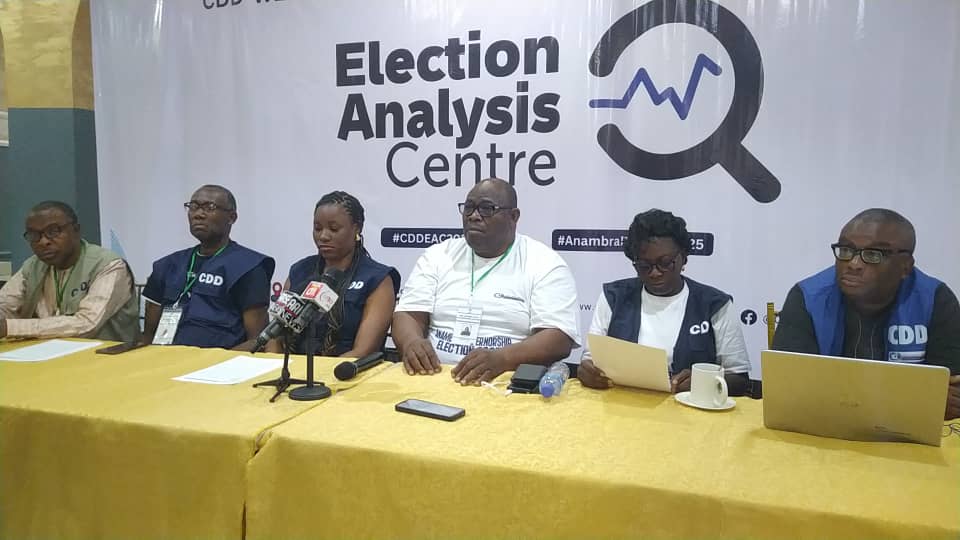
The Centre for Democracy and Development (CDD) and its Election Analysis Centre (CDD EAC) have released their post election assessment of the 2025 Anambra Governorship Election, acknowledging notable progress while pointing to persistent challenges that demand urgent reforms ahead of future polls.
In their joint statement, signed by Dr. Dauda Garuba, Director of CDD West Africa, and Professor Victor Adetula, Chair of the Election Analysis Centre, the observers said their conclusions were drawn from extensive field monitoring across the state during the election.
The report examines critical areas that shaped the conduct and outcome of the poll, including the performance of electoral institutions, security deployment, vote trading, voter participation, and the growing impact of information disorder.
CDD noted that the Independent National Electoral Commission (INEC) recorded significant improvements, citing its 98.8 percent PVC collection rate, 99.62 percent result upload on the IReV, and a largely peaceful voting environment. However, the body highlighted operational lapses such as late arrival of officials at 5.4 percent of polling units and weak voter mobilisation by political parties.
On security, the group reported that the deployment of over 45,000 security personnel contributed to the peaceful atmosphere, although 12.7 percent of polling units still had no security presence. It warned that heavy election security does not resolve the long term vulnerabilities of flashpoint communities once personnel are withdrawn.
CDD also flagged widespread vote buying in several local government areas, with cash and digital transfers ranging between ₦2,000 and ₦10,000 per voter. The organisation described the practice as a damaging trend increasingly relied on by political actors in the absence of issue based campaigns and credible governance.
Despite the high number of registered voters, turnout stood at 21.4 percent, an improvement from 2021 but still indicative of waning public trust. The report noted that many young people stayed away from the polls, while women and persons with disabilities faced accessibility barriers.
On information disorder, CDD said it tracked more than 200 election related claims, 54 percent of which were false. It noted that disinformation actors weaponised insecurity, hate speech and artificial intelligence to distort public perception.
The organisation concluded that Nigeria’s electoral weaknesses stem from broader governance failings, calling for strengthened institutions, improved INEC operations, sustained security structures, prosecution of offenders, and active collaboration among media, civil society, and security agencies to counter disinformation.
As the nation moves toward the 2026 offcycle elections and the 2027 general elections, CDD urged authorities to prioritise reforms that will restore public confidence and safeguard the country’s democratic future.
