
By Law Mefor
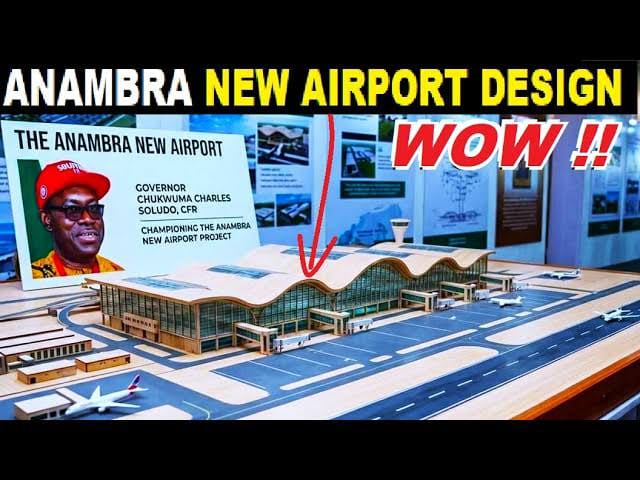
Here are some missed big issues in the conversation on why Governor Chukwuma Charles Soludo bets big on Anambra Aerotropolis as a key driver for the state’s industrial future. When profound change comes upon a society, plenteous doubters always meet it. History speaks to this fact. Anambra State Governor, Prof. Chukwuma Charles Soludo, CFR, is forging forward beyond the challenge of change by building the Anambra Aerotropolis, the first in Nigeria, perhaps. Soludo’s most important and enduring legacy may be the Anambra Aerotropolis, not the roads or other infrastructure. The Anambra Aerotropolis – Nigeria’s first attempt at building an airport city – is a standout project.
There are only an estimated 80 aerotropolises worldwide and as many as 44,000 airports globally, according to aviation urbanism research. This distinction clearly shows that Prof. Soludo is not building just an airport. Unlike a standalone airport, the aerotropolis is a cluster of industries, logistics hubs, and businesses built around aviation infrastructure. The Anambra Aerotropolis under construction is indeed unique and serves as the quintessential enabler of Governor Soludo’s promise to transform Anambra State into the African-Dubai-Taiwan Silicon Valley (ADTS). Incidentally, one of the 80 aerotropolises in the world is in Dubai. It is, therefore, understandable why Soludo has to build an aerotropolis as an enabler of the transformation of Anambra into a Dubai.
The best time to build an aerotropolis in Anambra is now, as the population is encroaching on the small land space that hosts the nine million or so people, a number that will grow to 30 million in the next one to two decades. Crucially, Anambra is the second smallest state in Nigeria, after Lagos, in terms of landmass. But while Lagos is expanding through land reclamation from the sea, Anambra is shrinking from erosion and flood devastation. What is more, unlike Lagos, Anambra is not an island and lacks sea access to reclaim land. Strategically, an aerotropolis is precisely what Anambra needs as its population surges and available land shrinks for its dual capacity. The Anambra aerotropolis will address both industrialisation and aviation needs of a significant population, the most populous state in the South East with the highest population density.
Furthermore, as shown in Dubai and similar examples, an aerotropolis is not a luxury but a necessary enabler for transforming and industrialising Anambra State. If not built now, the aerotropolis will miss its chance to position Anambra as a commercial and logistics hub within the next decade.
Governor Soludo understands the situation and knows that if the aerotropolis is not built now to fully qualify Anambra as a commercial and logistics hub, it will be too late. Those opposing this major and crucial leap towards an industrialised Anambra are blinded by the “palliative governance” that has characterised the state since Nigeria returned to the current democratic dispensation in 1999. The resolute Mr Solution, Professor Soludo, understands the stakes involved.
The bigger industrial picture is that the aerotropolis is being developed alongside the Anambra Mixed-use Industrial City (AMIC). Both projects have already secured from President Bola Ahmed Tinubu GCFR the coveted free trade zone status, a move the Soludo government knows will attract manufacturers, exporters, and investors with tax and customs incentives.
Strategically, the Anambra Aerotropolis under construction is pitched as the most central location in the South-East. Planners project it will serve the aviation needs of over 25 million people across the region, with a catchment area stretching to Akwa Ibom and Cross River States. What this development means is that Anambra Aerotropolis will host one of the potentially most viable airports in Nigeria and West Africa.
Experts say the design gives it the potential to become one of the most viable airports in Nigeria. The master plan also makes provision for a second runway in the future – a feature not currently available at any other airport in the country. The second runway, of course, is not expected to be built in the residue of Soludo’s administration but is being reserved for future governments. That’s forward-looking! Tied to a 50-year vision, the project is framed as a fulfilment of the Anambra Vision 2070, a 50-year development blueprint first conceived under Chief Willie Obiano and spearheaded by Soludo.
A former Central Bank of Nigeria (CBN) Governor and a globally lionised economist, Soludo has positioned the Anambra Aerotropolis as a 20- to 30-year play rather than a quick win.
Mr Solution understands that the state cannot be governed with palliatives alone. His is about intentional, transformational leadership that is willing to transgress and move against the wind.
Yes, the aerotropolis project has, as expected, faced push-back. Opponents have questioned the timing and cost, arguing that immediate needs like roads, erosion control, and social services ought to take priority. Others have raised concerns about land acquisition, compensation, and whether there will be enough airline and cargo traffic to sustain the operations.
The fact is that without long-term infrastructure, short-term interventions alone will not solve Anambra’s land and population challenges. When delivered as planned, the Anambra Aerotropolis and AMIC are designed to turn the state, crowned as the “Light of the Nation”, into a smart megacity – a place, in the government’s words, “to return to, visit, live, work, invest, relax and enjoy”.
For Governor Soludo, the bet is clear: build the hub now, and let industry, trade, and the next generation do the rest.
• Law Mefor, PhD, is Commissioner for Information & Value Reformation, Anambra State.