

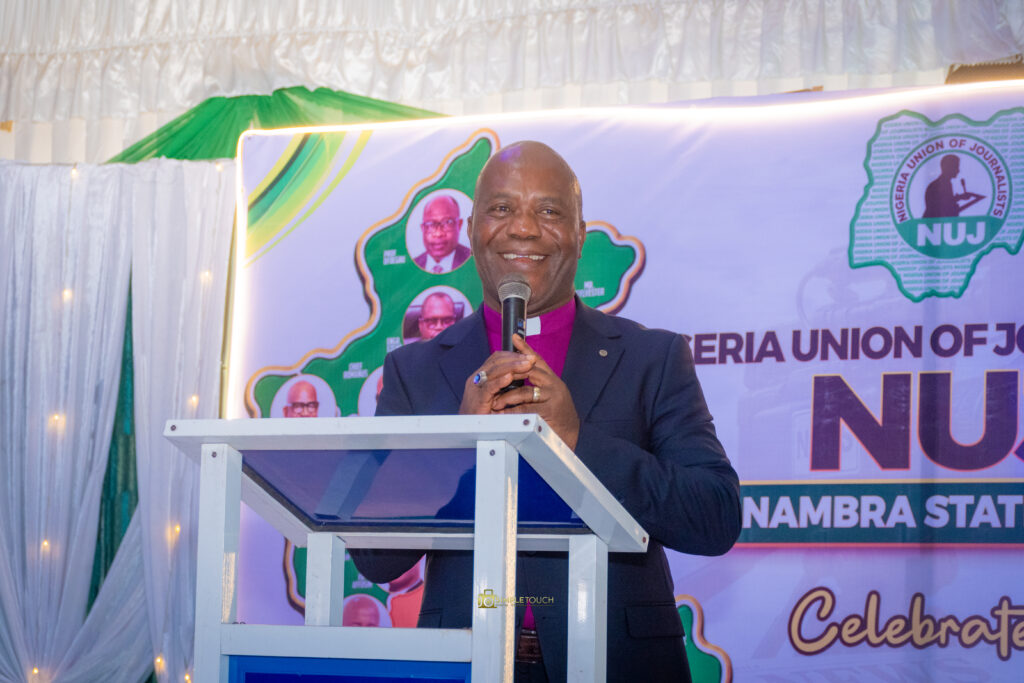
By Chidinma Olivia Patrick
The Bishop of the Anglican Diocese of Amichi, Rt. Rev. Ephraim Okechukwu Ikeakor, has challenged journalists to uphold truth, professional responsibility and public service, warning that practitioners who sacrifice the truth for personal comfort, financial inducement or political patronage undermine the foundation of journalism.
Ikeakor gave the warning while delivering the keynote address at the Nigeria Union of Journalists (NUJ), Anambra State Council’s 35th Anniversary, 2026 Press Week Grand Finale and Man of the Year Awards in Awka.
The celebration was held under the theme, “NUJ Anambra, 35 Years On: Reporting with Truth, Responsibility and Service… But…”
The Bishop said the anniversary should go beyond celebrating the NUJ’s achievements over the past 35 years and serve as an opportunity for journalists to reflect on where the profession had come from, where it stood and where it was headed.
He said the theme captured three fundamental responsibilities of journalism, reporting with truth, reporting with responsibility and reporting with service in mind, while the “but” at the end of the theme demanded deeper reflection on the challenges confronting the profession.
Speaking on reporting with truth, Ikeakor argued that journalists must go beyond simply presenting facts and must make deliberate efforts to establish the truth behind the facts.
“Not all facts are truth, but every truth is a fact,” he said, illustrating the distinction with an example of a person being seen inside a drinking parlour. He explained that seeing the person in the drinking establishment was a fact, but describing the person as a drunkard would not necessarily be the truth without establishing that the person had actually consumed alcohol.
According to him, the distinction underscores the need for journalists to investigate and establish the truth before presenting information to the public.
Ikeakor expressed concern over what he described as the growing prevalence of junk and yellow journalism, particularly with the rise of social media, and challenged journalists to return to the core principles of investigative and truthful reporting. He said the media’s watchdog role was critical to the survival of democracy because journalists must be able to hold governments, political leaders and other powerful individuals accountable.
“Journalism maintains democracy. Remove reporting with truth from journalism, democracy will go nowhere,” he said.
The Bishop warned journalists against becoming willing tools in the hands of politicians, government officials or wealthy individuals, stressing that a journalist who compromises professional integrity for personal benefit weakens the society he or she is supposed to serve.He declared,
“Any journalist who sacrifices truth on the altar of comfort and brown envelope is deadlier than a terrorist.”
He also challenged journalists who were afraid of the consequences of truthful reporting to reconsider their place in the profession.
“If you are a journalist and you are afraid of the truth, please resign. You have no business being a journalist,” he said.
Ikeakor stressed that reporting the truth often comes with consequences and requires courage, noting that the greatest preservation tool for a journalist was not merely technical skill or the ability to write, but the moral courage to stand by the truth.
“The greatest tool of a journalist is not the pen, but the spine,” he said, explaining that the “spine” represents the moral fortitude required to withstand threats, intimidation and pressure.
He urged journalists to develop the courage to remain truthful even when doing so makes them uncomfortable or unpopular with those in positions of authority.
According to him, journalism should reveal truths that people in power may attempt to hide, adding that the media must not sacrifice its watchdog role for access, political appointments or financial rewards.
The Bishop also cited the biblical injunction, “You shall know the truth, and the truth shall make you free,” stressing that when truth is hidden, individuals, institutions and entire societies remain in bondage.
He said the only effective way to confront falsehood and misinformation was through credible evidence and truth, particularly at a time when misinformation was increasingly influencing public discourse.
Turning to the second component of the theme, reporting with responsibility, Ikeakor said responsible journalism required accuracy, fairness and independence.
He urged journalists to verify facts, carefully assess their sources and avoid rushing to publish stories simply because they wanted to be the first to break the news.
“Reporting with responsibility means telling the truth as carefully and accurately as you can, giving people a fair picture, and keeping your reporting independent from personal agendas, pressures or interested parties,” he said.
He identified conflict of interest as one of the major threats to responsible journalism, warning that journalists and media organisations could lose their credibility when their reporting became influenced by personal, political or financial interests.
The Bishop questioned the practice of media organisations conferring awards on political figures primarily because of anticipated financial donations or other benefits, arguing that such practices could compromise the media’s ability to objectively assess public office holders.
He said once a journalist or media organisation became compromised by an interest, its journalism and reportage could lose credibility.
Ikeakor further warned that journalists were responsible not only for the information they disseminated but also for considering the consequences of putting such information into the public domain.
On the third component of the theme, reporting with service in mind, the Bishop said journalism should be understood as more than a career or content-creation business.
He described journalism as a calling to service, stressing that journalists serve individuals and society by helping people remain properly informed. He said the media’s role as the Fourth Estate of the Realm carried significant responsibility and should be treated with the same seriousness attached to other institutions serving society.
According to him, journalists should identify the information needs of the communities they serve and work towards meeting those needs rather than making the profession primarily about personal gain or political patronage.
Ikeakor also raised concerns about the financial dependence of media organisations on governments and wealthy individuals, warning that excessive dependence could weaken editorial independence.
He, however, advocated appropriate government support, including media subsidies and grants, provided such interventions strengthened rather than compromised the independence of the press.
He urged media organisations to diversify their sources of revenue and build sustainable models that would enable journalists to operate independently.
The Bishop further called for stronger investigative journalism, accurate documentation and effective information sharing, including a functional and regularly updated NUJ Anambra State Council website that could serve as a reliable source of information and documentation.
He urged journalists to see themselves primarily as servants of the people rather than servants of politicians, stressing that the media must continue to hold the powerful accountable and give voice to the voiceless.
At 35, he said, the NUJ Anambra State Council had reached a stage where challenges should inspire renewed action rather than become excuses for poor performance or professional compromise. He also called on governments at all levels to guarantee press freedom, freedom of information and an enabling environment for journalists and media organisations to operate effectively.
The keynote address formed part of activities marking the NUJ Anambra State Council’s 35th anniversary and 2026 Press Week, which also featured the presentation of the 2026 NUJ Man of the Year Awards and the Prof. Chinyere Stella Okunna Award for Ethical Journalism.
The event brought together journalists, government officials, traditional rulers, religious leaders, political and community leaders and other stakeholders. Reports from the event said Ikeakor’s address received a standing ovation from participants.
