

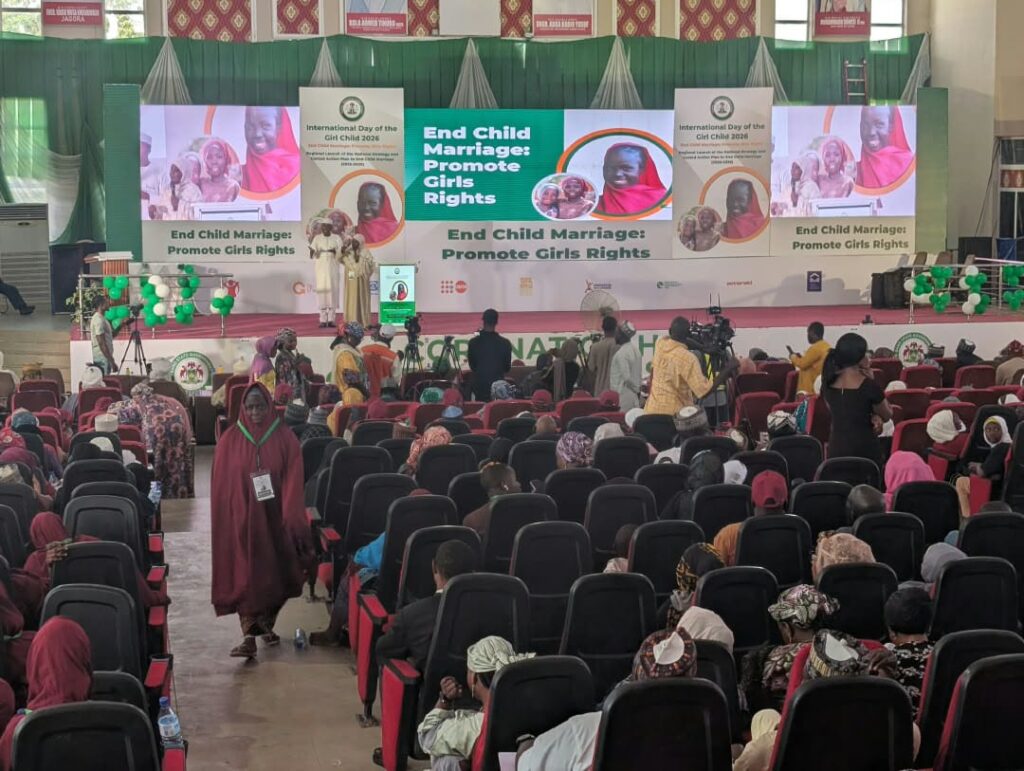



As part of efforts to protect girls from early marriage and ensure their access to quality education, the Federal Government has launched the National Strategy and Costed Action Plan on Ending Child Marriage in Nigeria (2025–2030) for the North-West and North-East geopolitical zones..
The launch which was organised by the Federal Ministry of Women Affairs and Social Development, took place in Kano, as part of activities to commemorate the 2026 International Day of the Girl Child.
In her keynote address, the Minister of Women Affairs, Hajiya Imaan Sulaiman-Ibrahim, pointed out that protecting the girl child required clear policies, effective laws, accessible services, adequate funding, reliable data and accountable institutions.
She explained that the Federal Government, through the ministry, was implementing policies and programmes to protect children, promote gender equality, strengthen families and improve the welfare of vulnerable groups.
According to her, President Bola Tinubu had declared 2026 the Year of the Family and Social Development, stressing that the vision could not be fully achieved if girls were denied the opportunity to complete secondary education because of child marriage.
The Minister noted with dismay, that child marriage disrupts girls’ education, exposes them to early pregnancy and associated health risks, increases their vulnerability to domestic violence and limits their economic independence.
She further noted the 2026 International Day of the Girl Child theme, “End Child Marriage and Invest in Girls’ Rights!”, calling on governments, families, communities and development partners to confront the practice while investing in girls’ education, health, protection and leadership.
She identified poverty, insecurity, gender discrimination, harmful traditional practices, school exclusion and inadequate social protection as factors contributing to child marriage.
Hajiya Imaan commended the Kano State Government for initiatives supporting girls’ education, including scholarships, free bus transportation for girls and the domestication of school re-entry guidelines for married adolescent girls. She urged other states to adopt similar measures.
Also speaking, the Kano State Commissioner for Women Affairs, Children and People with Special Needs, Hajiya Amina Sani, said the launch represented a collective commitment to protecting children’s rights and securing their future.
She highlighted the state’s AGILE Project, Girl Child Initiative, Free and Compulsory Education Policy and budgetary allocation to education as measures aimed at improving girls’ access to learning opportunities.
She called on parents, traditional and religious leaders, civil society organisations and the private sector to support government efforts to end child marriage and violence against children.
In his remarks, the Chief of UNICEF Field Office in Kano, Mr Shafeeq Ur-Rehman, said the Nigeria Demographic and Health Survey showed that approximately one in three young women nationally, and nearly one in two in the North-West and North-East, were married before the age of 18.
He cited Jigawa, Katsina and Bauchi among states with particularly high prevalence rates, noting that Kano also recorded a substantial burden.
Mr Ur-Rehman stressed that child marriage could not be addressed without tackling poverty, gender inequality, harmful social norms and gaps in essential services.
He urged state governments to translate the newly launched strategy into adequately funded programmes, stronger services and measurable results.
The Country Director of Save the Children, Duncan Harvey, emphasised the need for collective action to protect the rights of the girl child and eliminate harmful practices, including child marriage.
The event featured poetry recitals, traditional troupe performances and drama, among other activities, to raise awareness about child marriage and promote girls’ education and empowerment.