

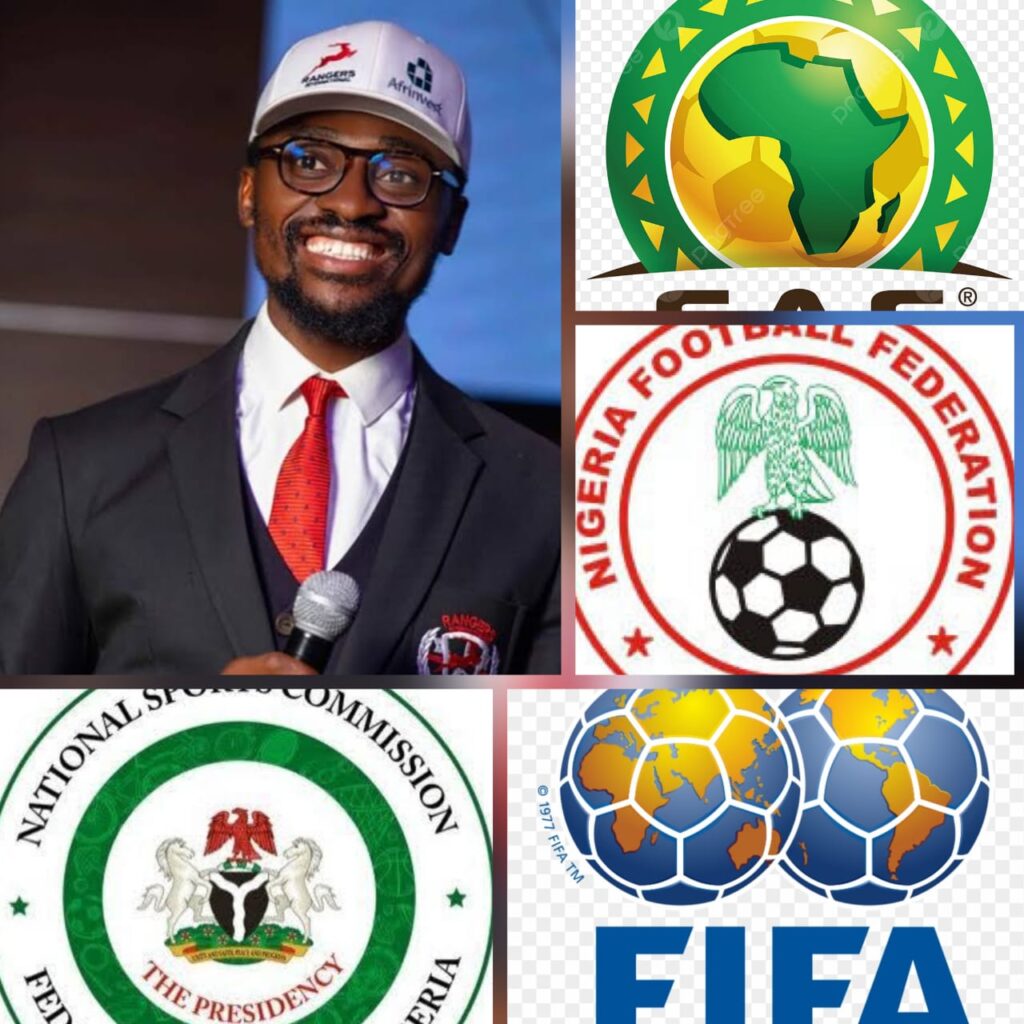
By Marvelous Ezenwa, Awka
Competence, Experience and Proven Results: The Case for a New Direction in Nigerian Football Administration.
At a critical momentum when Nigerian football requires stability, credibility and institutional renewal, the appointment of the right leadership for any proposed Normalisation Committee of the Nigeria Football Federation (NFF), must rise above politics, personal interests, tribal considerations and regional calculations. What Nigerian football needs is competence, experience, integrity and a clear understanding of modern football administration. In that regard, Barrister Amobi Ezeaku, a lawyer, FIFA- and CAF-certified football administrator and experienced General Manager, stands out as a highly qualified candidate whose professional credentials and track record deserve serious consideration by the National Sports Commission (NSC), FIFA and CAF.
Ezeaku brings together an unusual combination of legal expertise, football administration, professional club management and international training. His advanced football-management education, including UEFA- and FIFA-related Masters-level training in Club Management, has exposed him to contemporary principles of football governance, institutional management, commercial development, accountability and professional club administration. More importantly, his experience is not limited to academic certificates. His work at Rangers International of Enugu has provided a practical demonstration of what professional football administration can achieve when vision, structure and competence are brought together.
Under Amobi Ezeaku’s administration, Rangers International have recorded remarkable domestic success, winning two league championships within three seasons. Rangers secured their historic eighth league title in the 2023/2024 season after defeating Bendel Insurance 2–0, before being crowned champions again in the 2025/2026 season to claim their ninth domestic league title. Beyond trophies, his administration has also strengthened the club’s developmental structure, including the establishment of an academy and a women’s team that are making encouraging progress. These achievements provide tangible evidence that Ezeaku understands not only how to manage football institutions, but also how to build structures capable of producing sustainable results.
This is why the current conversation about the future of Nigerian football should not be reduced to who comes from where, who supports whom or which region should control the system. Nigerian football belongs to Nigerians, and no region, ethnic group or political interest owns its administration. If a Normalisation Committee becomes necessary, its composition should be based on professional competence, independence, credibility and the ability to command the confidence of the football family and international governing bodies. Nigeria cannot afford to sacrifice the future of its football on the altar of tribalism or political calculations. The priority must be to restore institutional confidence, strengthen governance, rebuild stakeholder trust and create a football administration that works for everyone.
For FIFA, CAF and the National Sports Commission, the choice of leadership should therefore be about capacity to deliver a credible transition and establish sustainable systems.
Barrister Amobi Ezeaku offers a compelling combination of legal knowledge, international football education, administrative experience and proven results at one of Nigeria’s historic football institutions. His understanding of both the domestic environment and international football standards could provide the balanced perspective required to navigate a difficult reform process. He represents a generation of football administrators who understand that modern football can no longer be run solely on passion, personalities or political influence; it requires professionalism, governance, financial discipline, development structures and accountability.
The call to consider Barrister Amobi Ezeaku as Chairman of a Normalisation Committee for the NFF should therefore be viewed as a call for competence to take centre stage. Nigeria has enormous football talent, history and potential, but restoring the country’s lost glory requires institutions that are professionally managed and built to last. With the right mandate, Ezeaku could bring fresh thinking, legal and administrative expertise, international best practices and a results-driven approach to the process of rebuilding Nigerian football.
At this defining moment, the message to the NSC, FIFA and CAF is clear: Nigeria deserves a football administrator whose credentials are matched by demonstrable results, and Amobi Ezeaku has made a strong case for that opportunity.
