

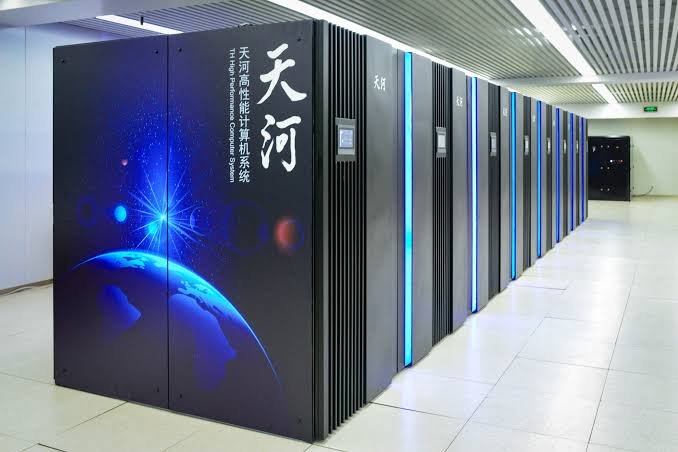
China has reclaimed the top spot in global supercomputing, with a domestically developed machine outperforming the world’s previous leader from the United States.
The latest TOP500 ranking, released on Tuesday, named China’s LineShine supercomputer as the most powerful in the world, marking the first time since 2017 that a Chinese system has led the prestigious list of global supercomputers.
Located at the National Supercomputing Center in Shenzhen, LineShine surpassed the US-based El Capitan system, which is housed at the Lawrence Livermore National Laboratory in California.
According to the ranking, the Chinese machine delivers computing speeds about 20 per cent faster than its American counterpart.
The achievement comes amid an intensifying technological rivalry between China and the United States, particularly in areas such as artificial intelligence, semiconductor development and advanced computing.
Supercomputers are used to perform highly complex calculations at extraordinary speeds.
They play critical roles in scientific research, weather forecasting, engineering simulations, drug development, national security and the training of advanced artificial intelligence models.
Chinese officials described the development as a major breakthrough in the country’s efforts to build an independent computing ecosystem.
The National Supercomputing Center said the project overcame several technological challenges and demonstrated China’s growing ability to develop advanced computing infrastructure without relying on foreign technologies.
One of LineShine’s most notable features is its architecture.
Unlike many of today’s leading supercomputers, which combine conventional central processing units (CPUs) with graphics processing units (GPUs), the Chinese system relies entirely on domestically developed CPUs and high-bandwidth memory technologies.
The development is particularly significant given US restrictions on the export of advanced semiconductor technologies to China.
Washington has imposed a series of controls since 2022 aimed at limiting China’s access to cutting-edge chips, especially those used in artificial intelligence and military applications.
Analysts say these restrictions have accelerated efforts by Chinese companies and researchers to develop alternatives using locally produced technologies.
According to the National Supercomputing Center, LineShine is already being used for a range of scientific and industrial applications, including climate modelling, engineering simulations, neuroscience research, drug discovery and artificial intelligence workloads.
Despite the milestone, some experts caution that leadership in the TOP500 rankings does not necessarily translate into dominance in artificial intelligence.
Industry analysts note that the benchmark used for the rankings was originally designed to measure traditional scientific computing performance rather than modern AI capabilities.
They also point out that several powerful AI systems operated by major American technology firms and defence institutions are not included in the rankings.
Nevertheless, China’s return to the top of the supercomputing rankings highlights the country’s continued investment in advanced technology and its determination to strengthen domestic innovation despite external restrictions.
The latest ranking underscores the growing competition between the world’s two largest economies as both countries seek leadership in the technologies expected to shape the future of science, industry and national security.