

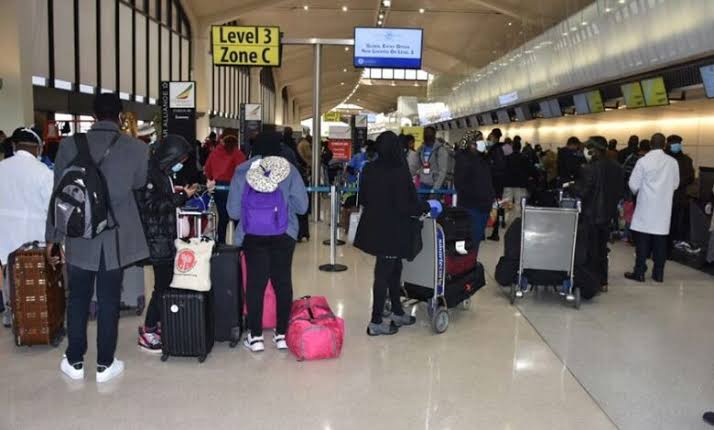
Report has it that some Nigerian companies are set to lose a huge number of their staff in August and September due to mass resignations as foreign schools resume academic activities in September 2022.
According to findings by Nairalytics from Human Resource managers across the country, it is a month where most foreign schools in the likes of the USA, Canada, Uk, and Australia are resuming academic activities, and with many Nigerian youths pushing to leave the country by applying for study visas, companies will be dealing with a number of vacant positions come August.
The concept of “The Great Resignation,” also known as Big Quit or Great Reshuffle, which became popular in 2021, when employees voluntarily resigned from their jobs in mass is already playing out in Africa’s biggest economy as HR managers revealed that they have processed a number of resignations in the past one month, most of which are due to traveling out.
Nigeria is currently ravaged by a number of socio-economic issues, some of which include insecurity, high cost of goods and services, and unemployment amongst others. Nigeria’s inflation rate is currently at 18.6% as of June 2022 one of the highest in Africa, while the unemployment rate stands at 33.3% as of December 2020, with an estimate of 40 million Nigerians without jobs.
This is coupled with the 5-month-old strike action by university lecturers as well as other security challenges affecting the country.
A recent article released by Nairametrics revealed that Nigerian youths are looking to leave the country using study visas, a term used to describe traveling out of the country, in search for greener pasture.

